
Meet Tess Oudoul, the voice behind Girls In Expat podcast

Today we're bringing you a slightly different format on the HubExpat Stories blog. Our guest: Tess, a French expat in the Netherlands and host of the podcast Girls In Expat. We spent a long time thinking about the best way to introduce her journey, and the answer turned out to be obvious: why not use the format she knows best? The interview. Except today, it isn't her voice you'll be listening to, it's her words you'll be reading.

Leaving France, Building a New Life
Tess opens with the basics: who she is, where she comes from, and where life has taken her since.
Hi, I'm Tess Oudoul. I'm a mother of two, soon to be three. I come from the south-west of France, from Pau specifically, the city where I was born and grew up. Today I live in The Hague, in the Netherlands, with my husband and children.

Ask her why she left France in the first place, and the answer goes back further than any single opportunity.
I was lucky enough to travel a lot with my family, but I don't think my desire to leave came only from a taste for discovery or travel. As a child, I struggled a bit at school. I sometimes felt out of step with others, or not as good as them. That created a kind of lack of confidence in me, but also a very strong need to prove to myself that I was capable.
Over time, that need turned into a desire for expansion, curiosity and adventure. I wanted to step outside the framework I'd grown up in, discover something else, confront the unknown, and see who I could become elsewhere.
Moving abroad was also a way of giving myself a new chance: to prove to myself that I could succeed, but also, somehow, to show others that I was capable of going far, of doing things I might not have dared to do had I stayed in my home environment.
So as soon as I had the opportunity, I went abroad for my studies, to do a master's in management and design of luxury fashion accessories. Then came professional opportunities, meeting someone abroad, and gradually, a real life choice.
Landing in the Netherlands, though, wasn't part of any plan at all.
For the Netherlands, and The Hague specifically, it wasn't a project we had planned or organised in advance at all. We had been living in Milan, Italy, for four years, and my husband was offered a professional opportunity in the Netherlands. We had never really considered expatriating there, it wasn't part of our plans, nor a deep desire but things moved fairly quickly.
So this move was really the result of chance. It wasn't a country we had chosen or imagined at the start, but an opportunity that came our way at a given moment.
Before the move, though, chance didn't make the anxiety any easier.
Before leaving, I was very anxious. Especially because we were leaving Italy after four emotionally intense years. In Milan, we had become parents of our first daughter, we had gotten married, and we had met incredible friends who were even there at our wedding. We had learned Italian, bought our first apartment... In four years, Italy had truly become home.
Leaving meant giving up a bubble where we were very happy, with solid landmarks and precious friendships, to head back into total unknown.
Arriving in the Netherlands, I felt a kind of emptiness. Everything had to be rebuilt: finding professionals we could trust, understanding a new country, a new culture, but above all recreating a circle of friends.
For me, beyond everything else, the most important thing in an expatriation is having solid people around you: friends you can call when you need to, with whom you can share the good times as well as the bad. They become your family there.
So at the start, I felt a lot of loneliness and isolation. And I think those are feelings that can really only ease with time and adaptation, of course.
And preconceptions? Sorry for my honesty, but yes, clearly. Despite myself, I had a lot of preconceptions and fears before arriving in the Netherlands. I was worried because of the weather, the language, but also the culture. After four years in Italy, I felt like I was going from one extreme to another, almost from white to black.
I wondered whether I would manage to find the same warmth, the same spontaneity, or the same ease at creating connections as in southern Europe. I think a lot of those ideas mostly came from the cultural difference and from the fact that I was leaving a country I was very emotionally attached to. Over time, I learned to put all that into perspective and to discover the Netherlands for what it really is.
So was she ever fully convinced? Not quite and she's the first to admit it.
Honestly, again I'll be frank, I was never convinced from the start that it was necessarily the right decision. And to be very honest, even today, it still happens that I ask myself the question and I'm not convinced by our choice two years later!
I've had a lot of moments of doubts, before leaving, during the settling-in period, and even still today, after several years here.
I should also say that I arrived in the Netherlands right after the birth of my second child. So I was in the middle of postpartum, in a very sensitive period, where you already feel particularly vulnerable, tired and sometimes isolated.
Adding a new expatriation on top of that, in an unknown country, with a newborn, was very intense emotionally for me, but also for my family and especially for the couple.
But looking back, I think those periods of doubt also gave me a lot. I really believe it's almost only in the moments when you feel lost that you understand better what you want, what you no longer want, and how you want to build your life.
Her Professional Life & the Podcast Project
Professionally, the move came at a cost.
Before leaving Italy, I worked freelance as a graphic designer. In Milan, I was part of a very solid group of entrepreneurs and, over four years, I had managed to build a real professional network. I had enough demand to make a living from my independent activity, which meant a lot to me.
Arriving in the Netherlands, everything changed quite abruptly. I lost the network I had spent several years building. For a few months, I kept working for some clients based in Italy, but the distance and lack of closeness meant that, little by little, the collaborations came to an end.
And above all, I arrived in the Netherlands right after the birth of my second child. I was in the middle of postpartum, with a newborn I had to look after full-time, around the clock. Between losing my network, the natural slowdown of my activity, and that very intense period with my baby, I had to put my professional career on hold. It was an enormous upheaval.
That pause didn't last, though and when the podcast idea resurfaced, it came with real excitement.
Before launching my podcast project, I was very enthusiastic. I really wanted to get stuck in, to create something of my own that was different, that could travel anywhere, and to get moving again.
I had already wanted to launch a podcast for years . But I didn't yet know when to do it, what to talk about, or how to build it. And especially that famous imposter syndrome we all know, right?
Finally, this second expatriation to the Netherlands, with all the moments of difficulty, the doubts, and the questioning they gave rise to, made me realise that it was the right time for me. Since my little Italian professional comfort zone had disappeared, I absolutely had to recreate my own.
I didn't really feel like anything was missing regarding the project itself. The only real thing I missed was not having, locally, a solid and ambitious network of women entrepreneurs, like the one I had in Milan. I sometimes felt that ecosystem was much less present, or less accessible here.
As for doubts, I didn't really have any about the substance of the project. I was very motivated and fairly clear about what I wanted to create. My questions were mostly about guidance: around me, no one really worked in this field, so I didn't always know who to turn to for support. I learned everything and tried everything on my own to get there and make my place as a professional in this particular medium.
But deep down, I had this very strong conviction that this project had to see the light of day, and that it was waiting for me.

Rewind further, and the idea was actually planted years earlier, during her first expatriation in Italy.
The idea was born during my first expatriation, in Italy. At that time, I was already listening to a huge number of podcasts. For me it was a real refuge, a space of my own, but also a very rich, precious and intimate source of information.
I've always loved speaking, sharing, passing things on and expressing myself out loud. Voice moves me enormously: I find it a very powerful tool, intimate and full of emotion. I already told myself I'd like to create a podcast, but I didn't yet know what to talk about, how to do it, or what place and subject I wanted to give it.
It was ultimately my second expatriation, to the Netherlands, that made everything clear. The difficulties I went through, the loneliness, the postpartum, the loss of my bearings, and the questions that raced through my mind... I experienced so many things all at once! But it made me understand that I needed to create a space for women going through the same things, without filters.
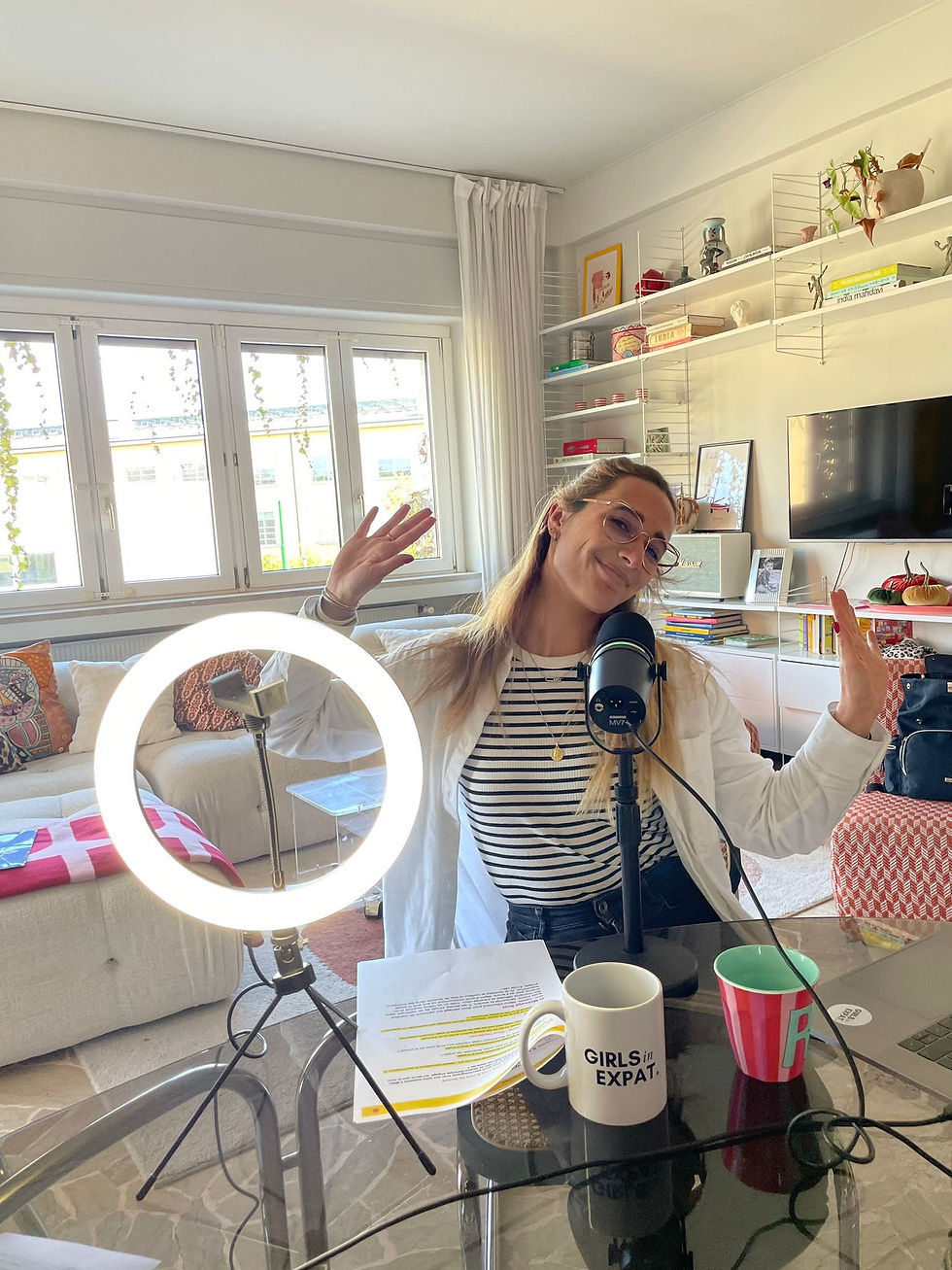
Today, I'm the founder and host of Girls in Expat, a podcast for French-speaking expat women who have dared to move, to expatriate, and to build a life far from their home country.
Ask her whether it came from passion or necessity, and she says: both.
I would say it came from both. First from a passion: to communicate, share, transmit, and build connection through the voice. I love this format so much, because it allows for a very special sense of closeness and emotion, creating a unique bond despite the distance.
But it also met a need. I went through real difficulties while living abroad, and I often told myself: I can't be the only one feeling this way, we need to talk about it!
I needed to create a place where expat women could recognise themselves, hear other stories, find answers, but also to feel less alone in facing their doubts, fears, or moments of questioning. Create a "next generation" format centered on the theme of expatriation, a field that is also evolving rapidly in this fast-changing world.
If there's one thing expatriation taught her, it's this.
Expatriation made me realize one essential thing: I can only rely on myself. When you expatriate alone, but also as a couple, a family, or with children, part of the experience remains deeply solitary. You often find yourself facing new situations that bring you back to your personal weaknesses or strengths, to important decisions that change your life forever, to moments of loneliness, and to difficulties that no one can truly go through in your place.
That was the moment I realized I was the only true master of my own destiny. Even though, up to now, it's my husband who has had the opportunities to move abroad, I am the one in charge with what I decide to do with my own experience abroad, whether personal, professional, or both!
If I want to make things happen, launch a project, find renewed meaning in my professional life, or build something that truly reflected who I am, it all has to start with me.
Expatriation gave me that click: stop waiting for things to happen, and instead dare to take my place, create my own opportunities, and move towards what I truly want to build, as a woman.
Launch & Obstacles
The decision itself came down to one very concrete piece of news.
I made the decision to launch the podcast about a year after we arrived in the Netherlands, in October 2025. The real trigger was an answer I received in June: my son had a daycare spot starting in September 2025.
The day I got that confirmation, the sky sort of "cleared" in my head , I can't quite explain it, and I immediately understood that my professional life would be able to resume. After several months entirely devoted to my children, my second baby whom I was breastfeeding, and to settling in, I knew that from September or October, I'd finally be able to take back full control of my professional life.
That's when I told myself: "The time is now. I can finally throw myself 100% into this podcast project I've been dreaming of."
Once the decision was made, the practical side turned out to be surprisingly smooth.
Honestly, on the administrative side, the Netherlands make things very easy. Everything is very structured, and digital, for people who want to start their own business, so I didn't run into any particular blockers there.
Financially, I decided to use my own resources to start the project. I wanted to move forward concretely, without waiting to have every guarantee or every perfect resource from day one.
On the technical side, I trained myself extensively, self-taught, over several months before launching. I also worked with freelancers online, in particular for music production and the podcast's identity.
As for confidence, I told myself that I could only rely on on myself. So I didn't really have a choice: I had to build maximum confidence in myself and in my project if I wanted to give it a chance to succeed.
To find my first guests, I was lucky enough to lean on the very solid network I had built in Milan and kept. They're inspiring women who trusted me very quickly and agreed to share their stories. And since the podcast carries a cause that speaks to them, putting expat women and their personal and professional journeys in the spotlight, finding volunteers ultimately wasn't that complicated.
On paper, at least, launching in the Netherlands turned out to be almost effortless.
Yes, it was extremely smooth. In the Netherlands, I was able to register as self-employed very easily: in a single day, with just one appointment, everything was done.
I honestly believe that, from that point of view, launching my business here was a real stroke of luck, almost a twist of fate. It was almost as if the conditions were all in place for launching Girls in Expat to be as simple and as obvious as possible.
After a period when a lot of things had been complicated personally and professionally, this administrative ease really let me move forward without wasting energy on endless procedures. It also let me save precious energy for what came next in growing my business.
Building the Girls in Expat community from the ground up meant leaning on connection above all.
Yes, I built this community from scratch, even though I obviously could rely on my solid base network, people I met in Italy, then in the Netherlands, who joined this adventure from the very beginning.
Girls in Expat addresses expat women with great sincerity, transparency and kindness. These are true stories, sometimes very intimate, in which women can recognize themselves, each in their own way. Sometimes, even without necessarily being expats themselves, women message me to say they recognize themselves in the episodes. And I believe it's this authenticity that naturally generates engagement around this podcast.
Concretely, I work a lot on my social media and I regularly reach out to women, professionals and people who might have a connection to the podcast and to expatriation. There are also expat women and professionals who reach out to me spontaneously to express their interest in the podcast, and sometimes beautiful collaborations emerge naturally in this way..
I use voice notes a lot to create a first contact. I find that voice conveys an energy, an intention, and a feeling, that writing doesn't always transmit. It's much more human, more direct and more personal.
Step by step, through exchanges, recommendations and episodes, the community grows around shared values: sharing, mutual support, and the wish to no longer experience expatriation alone.
Behind the podcast is a schedule shaped as much by motherhood as by entrepreneurship.
My days look, above all, like those of an entrepreneur who is also a mother of two children in everyday life. In the morning, I get the kids ready and take them to school. My workday really starts around 9am.
Then I go through calls with potential guests, I fine-tune interviews scheduled for the podcast, I create content for social media, I edit interviews already recorded, I think about upcoming topics, and I also record solo episodes about expatriation.
So I handle editorial preparation, interviews, production, editing, communications, partnerships, and the whole marketing development side of the podcast at once. There are also conversations with potential partners, side projects, for example, I recently had the opportunity to host a conference in Milan, about the podcast and about using voice as a powerful tool for developing a business today.
Launching Girls in Expat let me go well beyond what I thought I was capable of. It's a field I didn't know at all at the beginning, one where I had to learn on my own, train myself, move forward without always having landmarks, and yet still become a real expert on the subject. But that's also why I'm particularly proud of it.
At the end of the day, I pick up my kids and the evening routine begins: shower, dinner, bedtime. And it's not unusual that between 8 and 10pm, I go back to working on the podcast, to finalise content, reply to emails, or make progress on an episode.
There are days when I'm exhausted and go to bed late, that's true. But despite that, I feel a real, deep satisfaction, building something that has meaning for me, both personally and professionally.
Looking Back & Advice
So, does being an expat help or hurt when it comes to building a business? For Tess, the answer is clear.
For me, building a business while expatriated is a real advantage, even an additional force that you can grasp and use. First of all, because living in several countries, immersing yourself in different cultures, and stepping outside your original framework helps you develop a much broader outlook, as a human being and as a woman. You observe other ways of working, communicating, consuming, connecting with people, or developing a project. It is an open-mindedness you might not have acquired had you stayed in the same environment your whole life.
It's also very enriching from a professional and managerial point of view. When you discover other work cultures, other processes, other ways of managing a team or a company, you inevitably become more adaptable, more curious and more well-rounded about how to run a business or manage people.
And then, running a business abroad forces you to push your limits. You don't set off with all your points of reference, your network, or sometimes even your native language to make yourself understood in a meeting. You have to find your clients, dare to reach out to people in different languages, learn to introduce yourself differently, understand new codes, and make yourself visible directly at an international level.
You don't really have a choice, actually: you have to keep moving, go towards others, and build confidence in yourself to succeed as an expat.
So yes, expatriation definitely brings its share of difficulties, there is no point hidding it. But it's also those difficulties that make us considerably stronger, more resilient and more capable than others, in the end.
Two years in, how does it feel? Tess doesn't hesitate.
Today, I feel extremely well in my life as an entrepreneur. Honestly, I've never felt so much at the right place. I think this path had been waiting for me for a long time, but that I needed to live through certain experiences, certain difficulties and certain wake-up calls to have the courage to launch. Both personally and professionally.
And since I launched, I have had even more aspirations than before. I think that's what entrepreneurship does: you understand that the limits you set for yourself were simply and only in your head. You realise it's possible to create, to dare, to grow an idea and to go much further than you imagined.
I have a huge number of ideas and ambitions for growing Girls in Expat. I'd like this podcast to grow, to evolve, and to help more and more expat women around the world. I want this kind of "next generation" voice to continue expanding without limits. My ambition is also to build a real sisterhood around this community, with connection, support and a unique kind of solidarity.
And regrets? None. Truly, zero regrets. Seriously, even if tomorrow I get it wrong, even if the project evolves differently from what I imagine, I will never regret giving myself this chance.
Ask her for advice, and she doesn't hold back.
JUST START and THINK LATER!
I know that might sound crazy, but I sincerely believe our biggest obstacle is that very first step towards actually launching a project. Think about the fundamental basics before you start, of course, but really, jump and dive in directly! Think about what comes next afterwards, it will follow naturally if this project is the right one for you.
I'd also say: identify the people around you who might have a connection to your project or your future line of work before you launch. If there are inspiring people, professionals in the field, entrepreneurs who've already walked this path before you, go meet them. Ask for advice, for feedback from their experience. You learn an enormous amount from contact with others.
Then, I'd say you need to deeply believe in your vision and trust yourself. Everything starts there. You have to have confidence in what you want to create, even when everything isn't perfect yet, even when you don't have full control, or don't yet know exactly how you'll get there.
I'd also recommend getting closer to local chambers of commerce, expat associations, French-speaking networks, but also international and local networks. Every exchange can be valuable. You shouldn't stay only among people who look like you or speak your language, the most useful encounters sometimes happen where you least expect them.
And above all, free yourself from your fears, from that famous impostor syndrome we all know, and dare to move towards a project that truly drives you. Expatriation already teaches us to step outside our comfort zone. So we might as well use that strength to create something that looks like us, right?
As for the next ten years, Tess pictures something both familiar and wide open.
In ten years, I'd probably see myself in another country, but in a much more stable life. I'd like my children to have fixed landmarks, for us to really settle somewhere, and for us to no longer need to move.
I stay very open to new adventures and new projects that might come my way. Today, the podcast feeds me enormously and I have real ambition to grow it. But I don't want to close myself off from other opportunities that might come along my path by chance and let me discover myself differently again, as a woman, a mother and an entrepreneur.
Expatriation has removed a lot of barriers for me. It's taught me to put risk into perspective, to accept discomfort, and to understand that stepping outside your comfort zone is often where the most beautiful things begin.
So if, tomorrow, I have to step outside that comfort zone again and again to keep growing, discovering myself, improving, and setting a good example for my children, I will do it... always.

A big thank you to Tess for answering our questions so openly. Sometimes, moving abroad also means starting projects you'd never have imagined back home. For Tess, that's Girls in Expat, her podcast. You'll find it on all podcast platforms.
And you? Want to share your story too? Whether your life abroad has been a smooth ride or a bumpy one, we'd love to hear it. Drop us a line at justine@hubexpat.com and you could be our next HubExpat Story.


Comments